How to Control the Angle and Speed of
Railway Platform Turntables? A Guide to Operational Logic
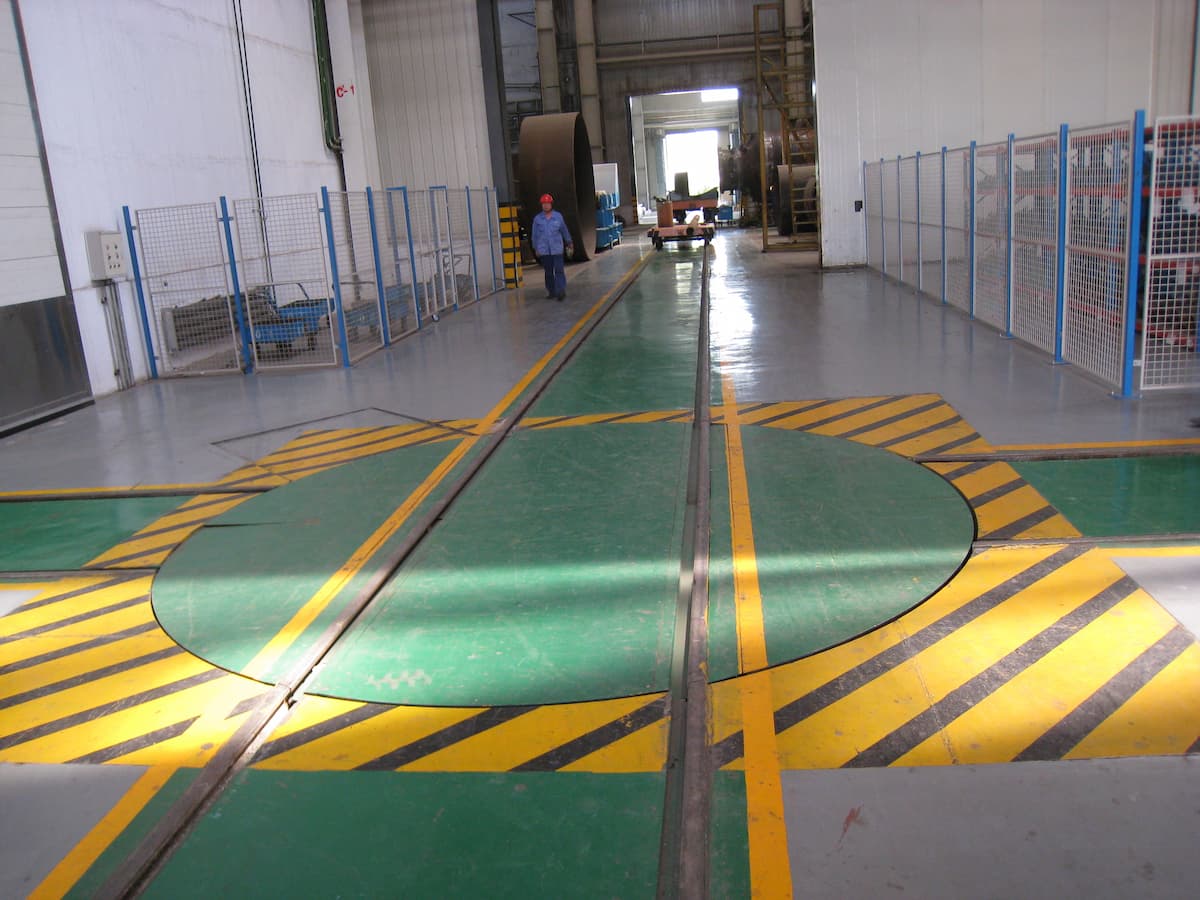
In modern manufacturing complexes and expansive industrial plants, when a heavy-duty rail platform wagon reaches the end of its track layout, the real operational challenge is not bringing it to a complete halt—it is how to change its heading direction in a graceful, precise, and highly controllable manner.
Relying on manual spotters, repetitive reverse shunting maneuvering, or dedicating massive factory square footage for sweeping rail curves is not only slow and inefficient but also significantly disrupts overall production rhythms and escalates shop-floor safety risks. To solve this critical bottleneck, the railway platform turntable (commonly referred to as an industrial rotation platform or rotary flat car device) has become an essential fixture across modern manufacturing spaces and outdoor logistics yards. By enabling rail cars to execute in-place direction changes, it transforms complex track-switching steering into a fully calculated, predictable, and highly repeatable automated process.
This leads to the core technical question: How exactly do you adjust and fine-tune the rotation angle, operating speed, and parameters of an industrial rail turntable? Let’s dive deep into the fundamental control logic that underpins these robust engineering systems.
Demystifying "Adjustment": The Three Core Pillars of Operational Control
In real-world shop-floor operations, when technicians discuss adjusting the angles and speeds of a heavy-duty turntable, they are essentially managing three distinct sets of operational parameters:
- Angle Adjustment (How far to rotate): Common industrial configurations require precise cross-track routing, such as changing directions by ±45°, ±90°, or ±130°. This allows the platform wagon to seamlessly transition from a main logistical trunk line to alternative alternative spur tracks.
- Speed Regulation (How fast to rotate): Rotation speed directly dictates factory cycle times and operational safety margins. High speeds optimize throughput but increase inertial risks; slow speeds maximize stability. Optimal velocity must be calculated based on specific load cases, floor conditions, and collaborative automated equipment.
- Directional Selection (Clockwise vs. Counter-Clockwise): For any target angle, the choice of rotation path significantly affects workspace clearance, operator safety zones, and structural interference with surrounding gear. Direction selection is never random; it represents the path of least resistance and optimal workflow logic.
The true value of a Weizhong industrial turntable lies in this complete programmability—allowing operators to dynamically scale angle, speed, and direction parameters to eliminate the classic physical constraints of heavy rail transportation layouts.
Angle Adjustment Control: Upgrading from "Rough Estimation" to "Micro-Precision Alignment"
Before heavy-duty rotation platforms were integrated, steering a rail flat car required extensive bypass loop track designs or tedious multi-stage shunting. A precision turntable compresses this extensive workflow into a singular, streamlined mechanical rotation.
The systematic logic of angle adjustment follows a strict automation sequence:
- Identify the target track vector (e.g., executing a ±90° perpendicular transfer from main line to branch line).
- Initiate platform rotation utilizing the designated, safest orientation path.
- Apply progressive deceleration and braking curves as the target angle is reached to ensure dead-center centerline alignment.
- Engage specialized track locking mechanisms, allowing the rail flat car to roll off smoothly onto the new track layout.
Why is absolute precision so crucial? Track systems leave zero room for error. If the alignment angle deviates even slightly, the flat car will generate excessive lateral friction and binding forces upon crossing the gap. This structural stress can stall operations, disrupt automated production rhythms, accelerate wheel-and-rail wear, and introduce latent structural hazards. In high-capacity mining and heavy industrial applications where loads are immense, precision angle control acts as the ultimate safety net for plant throughput.
Speed Regulation Logic: Balancing Velocity and Inertial Physics
A common misconception when first operating a rail turntable is striving for the absolute fastest rotation velocity. In heavy industry, speed settings must always balance cycle times against underlying physical laws:
- Mass and Inertia: The heavier the payload, the higher the rotational kinetic energy. Bringing massive tonnages to a sudden stop requires slow, controlled velocity profile curves to prevent load shifting.
- Environmental Synergy: In dense operational spaces where overhead gantry cranes, forklifts, and personnel cross paths, rotational speeds must stay within highly predictable, human-manageable limits.
- Production Cycle Optimization: On high-frequency automated assembly lines, rotation speeds should be programmed to max out right up to the safety threshold to prevent material handling bottlenecks.
Variable-speed control allows a singular turntable unit to pivot effortlessly between high-capacity, heavy-duty industrial slow-turning and rapid-cycle, empty-load high-speed returns. The objective is never "maximum speed," but rather mapping out the optimal acceleration/deceleration curve that mitigates risk while keeping logistics running smoothly.
Direction Selection: A Strategic Process Optimization Choice
Choosing between a clockwise (CW) or counter-clockwise (CCW) rotation profile may seem like selecting a simple toggle switch on a control pendant, but it actually dictates broader facility safety and material handling flow:
| Evaluation Factor | Strategic Impact on Plant Logistics |
|---|---|
| Spatial Clearance | Ensures the rotating platform tail swing avoids structural columns, adjacent machinery, and dedicated material storage racks. |
| Process Integration | Aligns the physical rotation with automated sensor sweeps and upstream/downstream cycle sequences, mitigating cross-traffic delays. |
| Continuous Flow | Maintains a linear, forward-moving logistical chain inside and outside the facility, cutting down on redundant material handling maneuvers. |
Broad Applications: Beyond Standard Rail Flat Cars
While these systems are prominently known as "rail platform wagon turntables," the underpinning engineering concept is highly versatile. Wherever a heavy-duty tracking vehicle operates and requires directional transformation, a rotational platform provides the optimal remedy.
Beyond standard heavy factory rail cars, Weizhong's specialized pin-gear drive engineering principles scale directly into:
- Indoor and outdoor heavy overhead gantry crane runway orientation shifts.
- Transit rail networks and subway maintenance facility depot marshaling cells.
- Heavy locomotives, bogies, and mainline train car engine directional turnaround bays.
In summary: controlling your industrial railway platform turntable effectively turns a complex logistics challenge into a standard, automated, and repeatable operational step. With our robust patented Pin-Gear drive system, you are not just installing a machine—you are ensuring long-term positioning reliability and absolute safety for your facility's material handling workflow.
Get a Professional Technical Quote
Contact us directly for comprehensive pricing, technical blueprints, and custom configuration details for our rail platform wagon turntables.
sales@360platform.com